Age of AI Puzzle - Fun IT Learning Game
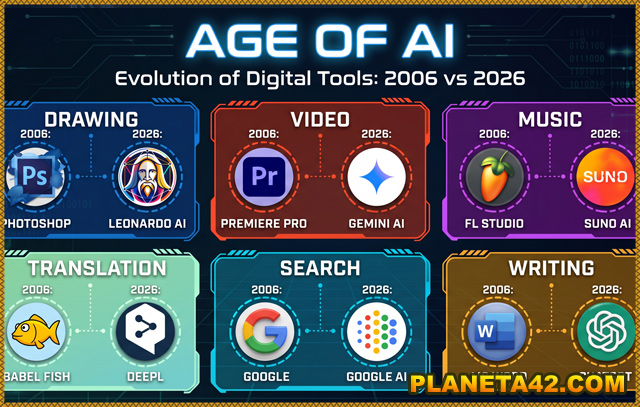
Age of AI Puzzle is a free online educational game designed to highlight the incredible leap in technology over the last two decades! Engage in interactive learning games by matching software icons from 2006 with their modern 2026 Artificial Intelligence counterparts to reveal them on the timeline. This digital exercise serves as a brilliant asset for game-based learning. Solve this drag-and-drop board directly in your web browser to increase your Knowledge Level! These cool educational games are perfect teacher tools, lesson aids, and engaging fun homework for IT classes. Enjoy play-based learning activities online, build a strong foundation in digital literacy, and discover fun educational games for students, browser-based educational games for kids, and free interactive games for primary school!
How to play the Age of AI Game
Observe the 12 circular icons in the top tray—each represents a digital tool from either 2006 or 2026. Roll your mouse over an icon (or tap it) to read the description at the top of the board. Next, drag the icon and drop it onto the correct covered slot located on the tech infographic board below. Match the classic software on the left and the modern A.I. on the right within each of the 6 categories. When placed correctly, the cover will disappear and reveal the software icon underneath! Connect all 12 tools to win the game and claim your Knowledge Level!
Knowledge Achievements:
Successfully completing the timeline rewards you with +1 Knowledge Level.
Did You Know? The Rapid Rise of A.I.
Fascinating facts about the evolution of digital productivity:
From Manual to Generative
In 2006, software relied entirely on human input. By 2026, generative A.I. can produce original art, videos, and music from simple text prompts.
The Neural Network Boom
The massive leap in A.I. capabilities was fueled by modern graphics processing units (GPUs), which train complex neural networks exponentially faster than older CPUs.
Language Processing
Early translation tools translated word-for-word, often failing context. Modern Large Language Models (LLMs) understand nuance, tone, and complex grammar flawlessly.
Class Subject: Digital Tools 2006 vs 2026
Review the 6 sectors where Artificial Intelligence changed the way we create and explore:
1. Drawing
From manually painting pixels and layers in Photoshop (2006) to instantly generating highly detailed, imaginative artwork with Leonardo AI (2026).
2. Video
From splicing and rendering raw footage in Premiere Pro (2006) to producing hyper-realistic, dynamic video clips directly from text using Gemini AI (2026).
3. Music
From arranging virtual instruments and samples in FL Studio (2006) to generating full-length songs with vocals and melodies via Suno AI (2026).
4. Translation
From the basic, often comedic literal translations of Babel Fish (2006) to the highly accurate, context-aware linguistics of DeepL (2026).
5. Search
From typing keywords and hunting through pages of blue links on classic Google (2006) to conversing and getting direct, synthesised answers from Google AI (2026).
6. Writing
From typing out every word on a blank MS Word document (2006) to brainstorming, drafting, and editing whole articles in seconds with ChatGPT (2026).