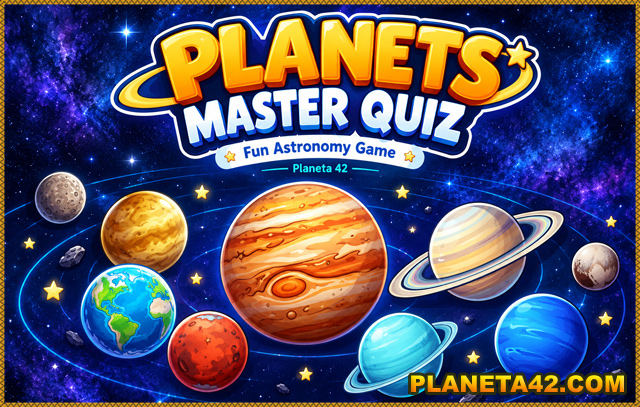
Planets Master Quiz - Fun Educational Astronomy Game for Kids
The Planets Quiz is a free online educational game designed to test and expand your knowledge of our Solar System! This interactive planets quiz features three distinct stages designed for comprehensive game-based learning: identification by planetary names, recognizing planetary orbital positions from the Sun, and matching specific astronomical characteristics. Perfect as interactive learning games for students and cool educational games for kids, this browser-based educational game offers instant feedback with dynamic scoring. Teachers can utilize this digital tool as effective lesson aids, teacher tools, and fun homework assignments in science and astronomy classes.
How to play the Planets Master Quiz
The game progresses through 3 challenge stages:
Stage 1: Planets Names — Read the upper message prompt asking for a specific planet and click the correct celestial image among 5 randomly presented options.
Stage 2: Planets Order — Identify planets based on their numerical order from the Sun (1st to 9th position).
Stage 3: Planets Specifics — Answer intriguing science questions about extreme characteristics, rotational axes, atmosphere, and surface facts.
Scoring: Correct clicks earn +10 points, while wrong choices lose -5 points and eliminate the incorrect planet from the options. Maintain over 85% accuracy across all 27 questions to pass the exam and win your Knowledge Level!
Knowledge Achievements:
Achieving over 85% accuracy in the planets quiz unlocks +1 Knowledge Level.
Did you know? Incredible Solar System Facts
Fascinating space trivia featured in our planets quiz:
Retrograde Venus
Venus rotates in the opposite direction to most other planets, meaning on Venus, the Sun rises in the west and sets in the east!
Sideways Uranus
Uranus has an extreme axial tilt of nearly 98 degrees, effectively spinning on its side as it orbits around the Sun.
Pluto & The Kuiper Belt
Pluto was reclassified in 2006 as a dwarf planet and remains one of the most famous bodies residing in the vast Kuiper Belt beyond Neptune.
Subject Matter: The 9 Featured Celestial Bodies
Overview of planets covered in this educational planets quiz:
1. Mercury
The closest planet to the Sun and the smallest major planet in our solar system, experiencing dramatic temperature extremes.
2. Venus
The hottest planet in our solar system due to a runaway greenhouse effect, rotating backwards relative to most planets.
3. Earth
Our home planet, the third from the Sun, and the only known celestial body in the universe to harbor life.
4. Mars
The Red Planet, home to Olympus Mons, the tallest volcano in the solar system, and ancient dry riverbeds.
5. Jupiter
The largest planet in the solar system, famous for its Great Red Spot—a giant storm larger than Earth.
6. Saturn
Renowned for its breathtaking system of ringlets made of ice and rock particles, and dozens of moons.
7. Uranus
An ice giant with a distinct pale blue-green color, characterized by its almost horizontal axis tilt.
8. Neptune
The outermost giant planet, known for having the fastest supersonic winds recorded anywhere in the solar system.
9. Pluto
A dwarf planet in the Kuiper Belt, formerly classified as the ninth planet from the Sun until 2006.