Solutions & Mixtures Puzzle - Fun Educational Science Game
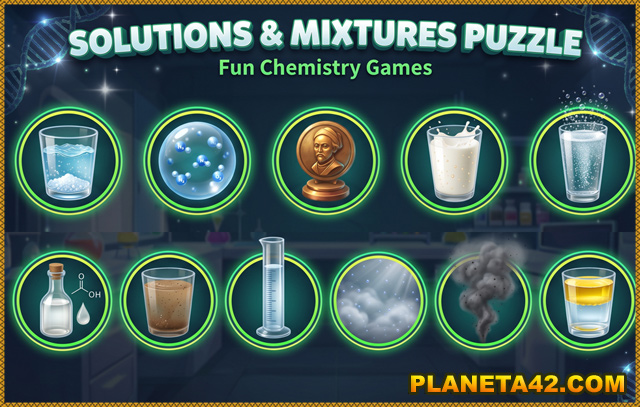
The Solutions & Mixtures Puzzle is a free online educational game designed to explore the fundamental chemical states of everyday substances! Engage in game-based classroom learning by matching 11 familiar mixtures—like milk, bronze, and carbonated water—with their correct chemical classifications, such as colloids, alloys, and suspensions. This digital exercise serves as an excellent tool for learning through play, helping you understand how different elements and compounds interact in nature. Solve this puzzle directly in your browser to increase your Knowledge Level! These cool educational games act as perfect lesson aids, teacher tools, and engaging fun homework for STEM and Chemistry classes. Enjoy play-based learning activities online and discover fun educational games for students and free interactive games for primary school!
How to play the Solutions & Mixtures Game
Examine the 11 mixture icons in the upper tray. Hover over an icon (or tap it) to read a hint about its composition and everyday use in the top panel. Notice that its exact chemical term is hidden to test your knowledge! Drag the substance and drop it into the correct circular slot marking its scientific classification (e.g., Gaseous Solution, Emulsion, Aerosol) located on the board. If the match is correct, the piece will snap into place. Categorise all 11 solutions to win the game and claim your Knowledge Level! Our online learning games for students make complex topics easy and fun.
Knowledge Achievements:
Successfully equipping the lab rewards you with +1 Knowledge Level (HTML Games do not increase the site level).
Did you know? Fast Facts about Solutions
Interesting facts about how substances mix together:
Solute vs. Solvent
In a solution, the substance being dissolved is called the solute (like salt), and the substance doing the dissolving is the solvent (like water). Water is often called the "universal solvent"!
The Tyndall Effect
You can tell a colloid from a true solution using light. If you shine a laser through a colloid (like milk or fog), the beam becomes visible because the suspended particles scatter the light.
Saturation Limits
A solution is "saturated" when it cannot dissolve any more solute at that temperature. If you heat it up, it can usually dissolve more, creating a supersaturated solution!
Subject Matter: 11 Solutions and Mixtures
Review the chemical states you will categorise in the game:
1. Salt Water (Homogeneous Solution)
A completely uniform liquid-solid solution where sodium chloride is fully dissolved and distributed equally in water.
2. Air (Gaseous Solution)
A uniform mixture of gases, primarily consisting of nitrogen and oxygen, along with trace amounts of argon and carbon dioxide.
3. Bronze (Solid Solution / Alloy)
A solid metallic solution typically made by dissolving tin into molten copper, resulting in a harder and more durable material.
4. Milk (Colloid / Emulsion)
A stable heterogeneous mixture where tiny liquid fat droplets are dispersed evenly throughout a water-based liquid.
5. Carbonated Water (Gas-in-Liquid)
A solution created by dissolving carbon dioxide gas into water under high pressure, creating characteristic bubbles when opened.
6. Vinegar (Liquid-in-Liquid)
A homogeneous mixture composed of acetic acid completely dissolved in liquid water.
7. Muddy Water (Suspension)
A heterogeneous mixture containing solid soil particles large enough to eventually settle out of the liquid if left undisturbed.
8. Alcohol & Water (Miscible Liquids)
Two liquids, such as ethanol and water, that have the ability to mix together perfectly in any ratio without separating.
9. Fog (Liquid Aerosol)
A colloid consisting of tiny liquid water droplets suspended in a gas (the air), often reducing visibility.
10. Smoke (Solid Aerosol)
A colloid comprising microscopic solid ash and unburned carbon particles floating and suspended in the air.
11. Oil and Water (Immiscible Liquids)
Two liquids that repel each other and do not dissolve, causing them to separate and form distinct layers.